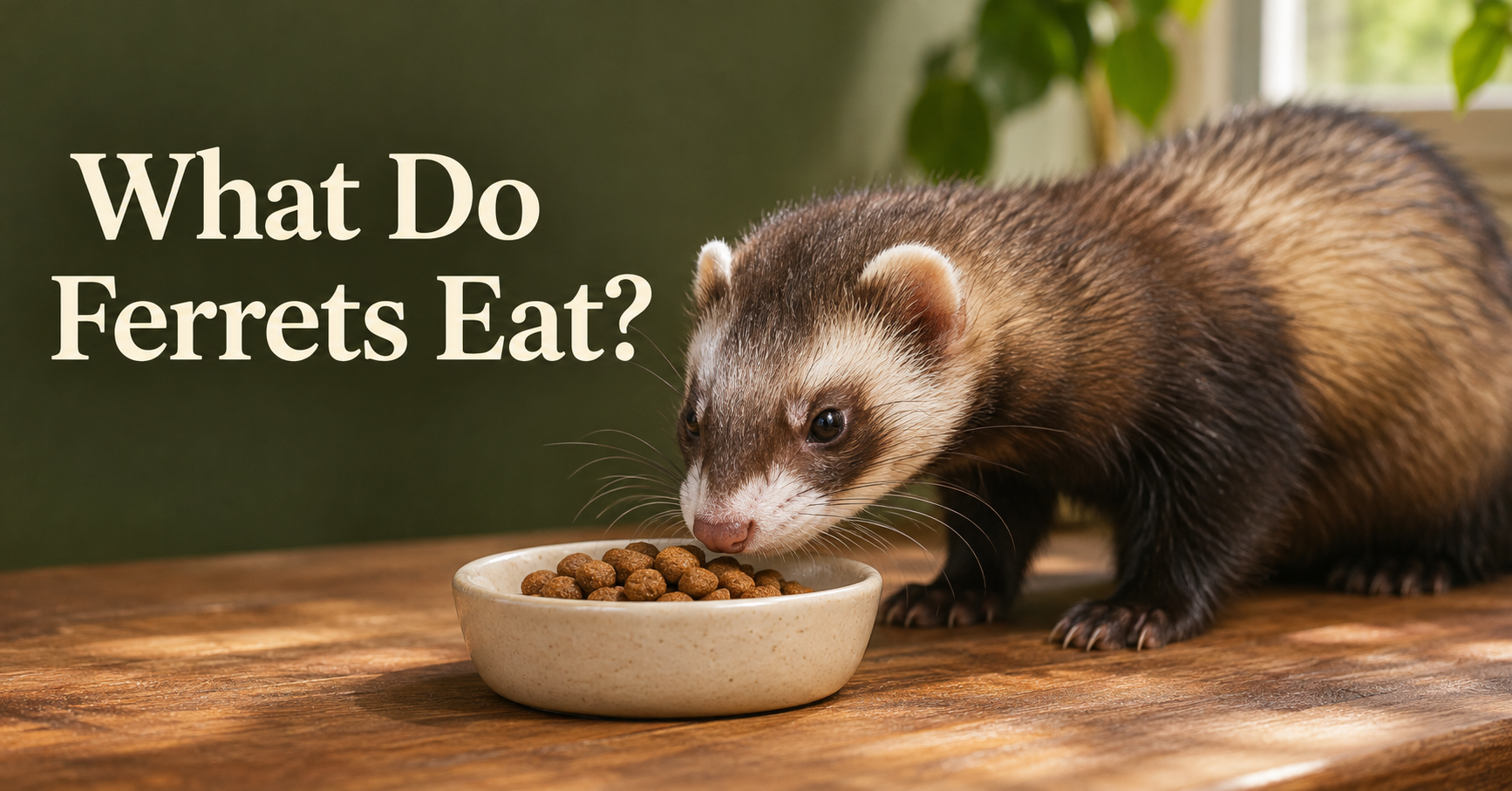
What do ferrets eat at home? If you are standing in the pet food aisle, look first for a complete ferret food suited to your animal’s life stage. Ferrets are obligate carnivores. They need a diet rich in digestible animal protein and fat, with little fiber. A small piece of cooked chicken can be a treat, but a bowl of chicken breast alone leaves nutritional gaps.
Out on the American prairie, the answer is far more specific: black-footed ferrets depend heavily on prairie dogs. In New Zealand, feral domestic ferrets often feed on European rabbits and take other animals where opportunities arise. The 36 foods below put each example in its setting, from a newborn kit’s first meal to the prey that supports a wild population.
What do ferrets eat at each life stage and in each habitat?
| Ferret | Main food | What matters most |
|---|---|---|
| Nursing domestic kit | Its mother’s milk | Successful nursing and steady growth, followed by gradual weaning |
| Weaned pet ferret | Complete, life-stage-appropriate ferret food | Frequent access to suitable food and fresh water |
| Recovering pet | A veterinarian-selected ration, sometimes a carnivore recovery food | The cause of poor intake and whether the animal can eat safely |
| Wild black-footed ferret in North America | Prairie dogs, with alternative small mammal prey | Access to both prey and an extensive burrow system |
| Feral domestic ferret in New Zealand | Often rabbits, with locally important rodents, birds, and other animals | Local abundance, season, and the vulnerability of native wildlife |
Choosing a staple when the packages look alike
Read the nutritional-purpose statement before comparing flavors. A pouch of chicken treats and a bag of complete chicken-based ferret food can both feature meat first on the label. Only the latter is intended to provide the entire ration. Check whether it is intended for growth or adult maintenance, how to serve it, and how to store it after opening.
Ferrets have a short digestive tract and commonly return to food for several small meals. Observe one ordinary waking period. Does the pet swallow the food, stash it, drop hard pieces, or get pushed away by another ferret? Those observations are often more revealing than the amount you find left in the dish. A sudden refusal of familiar food, particularly with weakness or vomiting, needs prompt veterinary attention.
36 foods ferrets eat and where each fits
Items 1–8 cover household feeding, early life, veterinary care, and a conservation breeding ration. Items 9–36 cover mammals, birds, reptiles, and invertebrates documented in free-ranging diets. The numbering helps locate a food and does not rank its importance. Prairie dogs, for instance, are central to black-footed ferrets even though several alternative prey appear below them.
1. Complete ferret food
For a healthy pet, the most useful words on the package are the ones that say the product provides a complete diet for ferrets and identify the life stage it is intended to feed. A chicken picture or a high protein percentage answers a narrower question. Neither tells you whether the animal can live on the contents of that bag as its principal food. Check the feeding instructions and keep the original packaging, even if you put the food in a storage container.
A ferret takes several small meals when awake. Dry complete food can make that pattern easier to accommodate. In a home with two ferrets, watch each one visit the dish. The fact that someone empties it each day gives surprisingly little information about the smaller or quieter animal. Look underneath blankets and behind furniture if food seems to disappear unusually fast. A stash is food carried away, and some of it may never have been eaten.
Use the package directions as a starting point and follow the individual animal’s weight and condition. For a change of food, keep some of the familiar product while introducing the new one gradually. A ferret that consistently sorts out the new pieces is still eating its old ration, even when the proportions you pour into the bowl suggest the transition is nearly complete.
2. Mother’s milk
The first food of a ferret kit is milk from its mother, called a jill. A newborn can depend entirely on this animal-derived food despite having no ability to hunt or chew meat. Nursing provides water and energy in a form the kit can use. The mother also supplies warmth and care, so a quiet litter lying close against her is in a very different situation from an isolated kit found cold and unresponsive.
As the kits grow, they begin to investigate suitably soft, complete food while they are still nursing. The first lick of solid food is only one step toward independence. A youngster may explore a dish, climb over it, or carry traces of food on its face without consuming enough to sustain its growth. Following each kit’s weight and watching it eat gives a clearer picture than checking whether a communal dish was disturbed.
Domestic ferrets usually finish weaning around six to eight weeks of age, with individual variation. An orphan, a kit that cannot nurse, or one losing weight needs prompt help from a veterinarian experienced with ferrets. Household milk and improvised feeding mixtures cannot reproduce the mother’s care or reliably meet a neonate’s needs. Milk in this context belongs to a particular animal and a brief developmental stage. It offers no reason to give dairy treats to a weaned pet.
3. Cooked chicken
A little plain, fully cooked chicken is a straightforward treat for a healthy domestic ferret. The simplest way to obtain it when cooking for the household is to set aside an unseasoned piece before adding sauce, stock, garlic, or salt. Remove bones, allow the meat to cool, and offer a small piece that the ferret can manage. Pulling the coating off a piece of fried chicken leaves much more uncertainty about what else the animal will eat.
Chicken is a good illustration of the distinction between a protein source and a complete diet. Muscle meat provides animal protein but has a different mineral balance from a formulated ration. If an owner replaces breakfast with chicken, then gives a second helping because the pet ate eagerly, the missing nutrients become more important with repetition. A small addition to an otherwise appropriate diet serves a different nutritional role from a bowl of chicken served day after day.
The mild flavor also makes chicken a useful example of how to observe food preferences. Offer it separately when you first try it, and watch whether the animal eats or hides the piece. Retrieve perishable leftovers from bedding and hiding places. A ferret that turns down a new treat while readily eating its normal food is giving a different signal from one that suddenly refuses both.
4. Cooked turkey
Plain cooked turkey can give a meat-eating pet a small reward, particularly in a household where turkey is already being prepared. What matters is the particular piece. Fresh unseasoned meat cooked through is a different food from deli turkey, smoked turkey, a slice from a heavily brined roast, or meat covered in gravy. Take a little from a plain preparation, remove bone, let it cool, and cut it into manageable bites.
Turkey can be convenient for reward-based handling because the keeper can divide a small amount into several tiny pieces. Count the total offered during the session. The ferret experiences each reward as a separate event, but nutritionally all those pieces add up. If different family members offer treats independently, one person can easily underestimate how much turkey has displaced the pet’s main food by the end of the day.
A turkey-flavored complete ferret diet has a different purpose. Its manufacturer combines ingredients to supply the nutrients the animal should receive across meals. Fresh turkey muscle on its own does not reproduce that formulation, however similar the two foods may smell. That distinction becomes especially important when a ferret accepts turkey but starts leaving its usual ration. Check the animal’s overall intake and seek veterinary advice if the change persists or is accompanied by weight loss.
5. Cooked beef
A small morsel of plain, thoroughly cooked beef is another possible occasional treat for a ferret. Choose a tender piece that the animal can handle and keep it separate from seasonings. Beef jerky, cured meat, a greasy piece of hamburger with condiments, and meat from a seasoned stew all come from cattle, yet each brings a different set of ingredients to the bowl. The name of the animal on the menu is only the beginning of a useful food description.
Ground beef deserves particular attention because a bowlful looks like a plausible carnivore meal. Grinding changes the texture of muscle tissue. It does nothing to correct the balance of calcium, phosphorus, vitamins, and other nutrients. Rotating ground beef with ground turkey and chicken also leaves the household serving three versions of a muscle-meat diet. Variety in animal names can conceal repetition in the parts actually fed.
If you want to know whether a treat agrees with the pet, introduce one plain food at a time in a small amount while keeping the main ration consistent. This gives a clearer account of what the animal ate if a problem develops. A ferret that regularly seeks out beef may have a strong flavor preference. That preference is worth noting for handling or training, without treating it as evidence that a daily beef ration would meet its needs.
6. Cooked hen’s egg
A piece of plain, fully cooked hen’s egg can be an occasional ferret treat. A little chopped hard-boiled egg is easy to separate from the rest of a human meal before mayonnaise, mustard, or seasoning goes in. Scrambled egg prepared with additives brings those ingredients along with it. The quantity appropriate for a small pet is also easy to overestimate when the starting unit in your kitchen is one whole egg.
Egg provides animal protein and, when the yolk is present, fat. Its role in a diet depends on the amount offered and what else the ferret eats. A few bites alongside an adequate complete ration are different from replacing several meals with eggs. A ferret offered a new texture may spend some time licking or carrying it without actually consuming very much. Watching that first encounter tells the owner more than checking an empty plate later.
Choose cooked egg for a household treat. Cooking reduces risks associated with raw egg and leaves no nutritional need to put a raw egg or its shell in the enclosure. Pick up leftovers and check the animal’s usual hiding spot. Egg also needs no sweetener or dairy to make it acceptable. A pet that declines it and returns to its ordinary food can simply leave this occasional item off its menu.
7. Veterinary carnivore recovery food
A ferret recovering from illness or surgery may be prescribed a concentrated recovery food formulated for carnivores. The clinician chooses it for a particular patient and gives instructions for preparation and intake. The small amount of food an unwell animal is willing or able to consume can make nutrient concentration especially important. A bowl of broth and a prescribed recovery food can look equally soft while providing quite different amounts of nourishment.
A ferret eating voluntarily from a shallow dish gives the caregiver useful information about appetite and swallowing. Record approximately what the animal ate and any vomiting, weakness, or difficulties the clinician asked you to monitor. A smear of food on the muzzle or a spill in the bedding is easy to count accidentally as intake. When several people share care, one written record prevents overlapping offers or missed information.
Loss of appetite itself needs an explanation. A stomach or intestinal blockage, dental pain, and systemic illness require different responses, and a food that helps one patient may be inappropriate for another. Contact a ferret veterinarian promptly about refusal of food. Do not start syringe-feeding or forcing a meal into a weak or vomiting animal without specific veterinary direction. The role of recovery food begins with the patient’s condition and ends when the clinician advises returning to the regular ration.
8. Toronto Carnivore Mix
Black-footed ferret conservation programs have used a prepared ration known as Toronto Carnivore Mix. The formulation was developed for managed carnivores and evaluated in black-footed ferrets, including during breeding and weaning. Its horsemeat base sometimes gets reduced in retellings to “zoo ferrets eat horsemeat.” That shorthand loses the distinction between a formulated ration with multiple components and a cut of muscle meat taken from a single animal.
The setting explains why a managed ration is useful. Staff need to feed many animals consistently, follow the condition of individuals, and adjust care through pregnancy, lactation, and growth. They can track what each animal receives and examine the nutritional composition of the product. An observer who sees a single feeding tray sees the portion at that meal, but usually sees little of the planning and monitoring that determine its contents.
Managed feeding also answers a different question from ecological restoration. An animal in a breeding facility can derive nutrients from a professionally formulated diet. A free-ranging black-footed ferret needs habitat where it can find and capture prey and reach safe shelter. The existence of a successful captive ration cannot replace the prairie dog colonies that support those activities. For household ferrets, use an appropriate domestic feeding plan. This particular historical formulation belongs to a specialist conservation setting.
9. European rabbits
In New Zealand farmland, European rabbits are a major food of introduced feral ferrets. The two animals’ histories there are connected. People introduced ferrets in attempts to control rabbits, and abundant rabbit populations supported a predator that also eats native wildlife. A rabbit-rich landscape can therefore influence animals that never compete directly with rabbits for grass. It supports a hunter capable of visiting their nests or taking other prey.
A rabbit represents more than the portion of boneless meat a shopper finds in a tray. A predator with access to a carcass may consume different tissues, and it can eat on multiple occasions. Consequently, several ferret meals can come from one rabbit. Finding rabbit remains in multiple droppings establishes repeated consumption more readily than it establishes the number of rabbits killed. A carcass can also provide food to an animal that did not make the kill.
The role of rabbits changes with place and season. In East Otago, rabbit and hare remains occurred particularly often in ferret diets in spring and summer. That local pattern should not be transferred to an indoor pet as a seasonal feeding schedule. If rabbit is an ingredient in a pet food, read the product’s nutritional purpose. Rabbit muscle sold alone and a complete ferret diet made with rabbit are different purchases.
10. Prairie dogs
For the North American black-footed ferret, a prairie dog town is both a pantry and a place to live. Prairie dogs dig the burrows in which ferrets shelter, travel, raise young, and encounter prey. Each animal is a rodent, despite the name “dog.” A healthy colony contains a network of underground passages and a recurring supply of prey. A patch of grass of the same area, without the colony, offers quite different prospects to the ferret.
Prairie dogs supply the bulk of this species’ food. Their exact share varies among sites and individual ferrets, and the method used to estimate diet matters. Counting identifiable remains in droppings answers a different question from estimating the food absorbed into an animal’s tissues over time. It is reasonable to describe a black-footed ferret as a prairie dog specialist without assigning one fixed percentage to every meal, season, or population.
The relationship also explains why a decline in prairie dogs matters twice. The immediate supply of prey falls, and the occupied burrow system that made prey accessible may deteriorate over time. Other small mammals can contribute meals, but their presence alone does not reproduce a prairie dog town. A pet ferret belongs to a different species and can receive a complete prepared diet without anyone obtaining prairie dogs for it.
11. Deer mice
Deer mice occur among the smaller rodents taken by black-footed ferrets in North America. A deer mouse is much smaller than a prairie dog, so the two prey animals contribute food on different scales. Capturing one mouse can be a useful feeding opportunity even where a prairie dog colony supports the predator over the long term. Counting the two encounters as one animal each would conceal the difference in the amount of food involved.
The name is also a reminder to identify which ferret and which mouse are under discussion. A deer mouse recorded on the American prairie is distinct from a house mouse taken by an introduced ferret in New Zealand. Both examples show that ferrets can use small rodents. They come from different ecosystems and offer no basis for transferring an exact prey preference, feeding frequency, or conservation conclusion from one location to the other.
In captivity, a mouse encountered in a garage comes with an unknown history. It may have contacted poisons, parasites, or other contaminants and could injure a pet. There is no need to arrange a live encounter to give a domestic ferret a satisfactory diet. A better household use of the natural observation is to recognize why small rodents need secure, separate housing whenever they share a home with a ferret.
12. Voles
Voles are compact grassland rodents recorded as secondary foods of black-footed ferrets. They often use vegetation and shallow runways that provide cover close to the ground. A ferret moving through a prairie dog colony can therefore encounter animals that use quite different parts of that landscape. The entire food supply is not confined to the occupants of the large burrows visible from a distance.
One reason to identify voles separately from mice is that their opportunities to meet a predator can change differently as ground cover changes. A field may look full of small mammals to a casual visitor, yet different species move along different routes and use different refuges. Diet observations establish which of those animals the ferret actually consumed. A list of mammals living in the same county can only suggest possible encounters.
An individual vole meal can be significant to the animal that caught it without making voles an adequate replacement for the prairie dog system. To assess that larger question, one would need information about the abundance and accessibility of voles, the total food they supply, and the availability of shelter for the ferrets. The distinction is useful for a reader puzzled by two apparently conflicting facts: black-footed ferrets eat multiple kinds of rodents, and their survival remains closely tied to prairie dog colonies.
13. Cottontail rabbits
Cottontails of the Americas are among the alternative foods recorded for black-footed ferrets. They belong to a different rabbit genus from the European rabbits that dominate many New Zealand feral ferret diets. The common word “rabbit” accurately identifies the general type of animal but loses the distinction between a secondary food in a prairie dog ecosystem and a major food supporting an introduced predator on another continent.
The age and size of a rabbit also affect what a feeding record can mean. A small young rabbit and a full-sized adult present very different opportunities. A piece of rabbit tissue reveals that feeding occurred while offering little direct evidence about whether the ferret chased an adult, found a vulnerable young animal, or used existing remains. The strongest descriptions preserve those distinctions whenever the original encounter was not observed.
For a pet owner the significance is mostly explanatory. Two related mustelids can make use of rabbit tissue, yet neither rabbit breed nor a “wild prey” picture on a package establishes that a retail product is nutritionally complete. A rabbit-based treat and a properly formulated staple can both appeal to a carnivore while serving different roles. Leave wild cottontails and their nests undisturbed. Their inclusion in the natural food web describes an ecological relationship, not a sourcing suggestion.
14. Ground squirrels
Alongside prairie dogs, black-footed ferrets can use other ground squirrels where the animals overlap. Here “other” is important because prairie dogs themselves belong to the squirrel family. The additional food refers to ground squirrels outside the prairie dog genus. The distinction lets us describe the dominant prey accurately while recognizing other burrowing rodents that may contribute to an individual ferret’s diet.
Colonial behavior makes some ground squirrels especially interesting when considering the history of ferret habitat. A colony may offer both prey and burrows, two resources a solitary surface-dwelling animal cannot supply in the same way. How far a given squirrel population can substitute for a prairie dog town is a separate ecological question. Its answer depends on the density of suitable burrows, seasonal access to prey, and how long those conditions persist.
For an observer, an animal disappearing into a squirrel hole establishes use of the hole. It might be seeking refuge, investigating scent, traveling below ground, or hunting. A witnessed capture or identifiable food remains provide stronger evidence for the meal. This is a useful distinction whenever photographs of a ferret near a burrow circulate without further context. The opening points to a feeding opportunity and a shelter resource, but the picture alone cannot tell which one the ferret used that night.
15. Pocket gophers
Pocket gophers are another occasional prey category described for black-footed ferrets. These rodents spend much of their time underground and are named for the external cheek pouches used to carry food. They differ from prairie dogs in social behavior and the arrangement of their burrows. Lumping all mammals that make holes in grassland under “gophers” can therefore blur both the prey identity and the kind of habitat it provides.
An animal living below ground can be abundant while remaining difficult for a human observer to see. Mounds offer clues to activity, although they do not reveal whether a ferret can enter an occupied passage, reach the gopher, or obtain a meal. For a terrestrial predator, access is part of the food supply. A census of animals present and a list of animals actually eaten can give substantially different impressions of the same patch of land.
The appropriate place for pocket gophers in a ferret diet account is among the alternative wild foods. Replacing prairie dogs with a long list of occasional rodents would exaggerate the flexibility of the black-footed ferret’s habitat requirements. Equally, erasing those alternatives would miss real feeding opportunities. In a backyard, a fresh mound is a reason to identify the animal that made it, rather than an invitation to introduce a pet ferret into the tunnel.
16. House mice
House mice can provide small mammal prey for feral ferrets in New Zealand. They live in farmland as well as around buildings, so the word “house” should not be taken too literally. A mouse using a grassy field margin or a dense patch of cover can encounter a ferret some distance from a human dwelling. The availability of mice gives ferrets another feeding opportunity in areas where rabbits are scarce or difficult to reach.
The scales involved are worth considering. Mouse hair can reveal a mouse meal even after the soft tissue has been digested, but its presence says little about how much energy it contributed relative to a much larger rabbit. Several kinds of remains can occur in the same sample. Adding up the percentage of samples containing each species can therefore produce a total above one hundred without implying that the animal ate an impossible amount.
Inside a home, the same prey relationship has straightforward implications. A mouse kept as a pet needs housing and exercise time physically separated from the ferret. Being well fed cannot be counted on to eliminate the ferret’s interest in a moving rodent. If a wild mouse enters the home, keep the ferret away from the encounter and from any bait or poisoned animal. Its regular diet can continue independently of the pest problem.
17. Rats
Rats contribute to the diets of some free-ranging ferrets, including animals using New Zealand forest habitat. A forest ferret that encounters rodents regularly may have a different diet from one hunting in open rabbit country. Looking only at grassland feeding records would miss this local flexibility. It would also obscure the risks to native prey that shares the forest floor with an introduced carnivore.
A rat that a ferret can reach is a more meaningful unit than a rat counted somewhere in the same tract of forest. Shelter, animal size, and activity at the time of an encounter influence whether the opportunity becomes a meal. The word “rat” may cover more than one local species when the remains cannot be identified precisely. It is better to retain that broader identification than to assign a particular species based on where a sample was collected.
Rats have also been used in managed black-footed ferret care, where trained staff select food and follow the condition of animals in a conservation program. That setting differs from finding a rat near a house or purchasing one on the assumption that whole prey is always nutritionally sufficient. The appropriate decision for an owner depends on a complete domestic feeding plan and food safety. There is no reason to expose a pet ferret or a pet rat to an unsupervised encounter.
18. European hares
Hares occur among the lagomorphs eaten by feral ferrets in New Zealand. A lagomorph is a member of the mammal group that includes rabbits and hares. The distinction matters because some dietary findings identify both animals separately, while others can establish only that rabbit or hare tissue was present. Treating every such observation as a confirmed hare meal would overstate the evidence, particularly where rabbits are abundant.
Hares do not live in communal rabbit warrens. Their use of open ground and surface resting places gives a predator a different set of opportunities. A young hare lying concealed, an adult capable of rapid flight, and a carcass found in a field can all contribute the same species name to a food list. They represent very different feeding events. An identification from hair alone usually cannot recover all of those details.
In interpreting seasonal patterns, this is especially relevant when prey are grouped together. A rise in lagomorph remains during a particular season does not establish that both rabbits and hares increased by the same amount. Their relative abundance may differ between fields a short distance apart. For anyone describing what ferrets eat, “rabbits are important, with hares also recorded” communicates more about that landscape than an unqualified suggestion that the predator routinely overcomes full-grown hares.
19. Brushtail possum tissue
Brushtail possum remains have been identified in the diet of feral ferrets in New Zealand. The possum in this account is the introduced Australasian marsupial, distinct from the opossums familiar to many North American readers. Calling the food “possum tissue” preserves a second important distinction. Finding hair or other remains in a ferret’s droppings confirms consumption more readily than it reveals how the tissue was obtained.
A carcass can supply food to several animals over time. A ferret visiting old remains is acting as a scavenger, whereas one taking a vulnerable live animal is acting as a predator. Both routes can produce much the same dietary evidence. The relative sizes of a mature possum and a ferret make it especially unwise to picture an attack on an adult every time the food appears in an account.
Scavenging can connect parts of a landscape that a straightforward predator and prey list would leave apart. A possum that spent much of its time in a tree can become available to a ground-searching mammal when its remains reach the forest floor. For a household animal, however, a found carcass has an unknown history, freshness, and disease status. The biological record explains why a ferret might investigate it and why the owner should prevent that contact.
20. Young hedgehogs
Remains of young hedgehogs have been found in ferrets’ diets in New Zealand. Age is unusually informative in this example. An adult hedgehog can curl up and present a dense barrier of spines. Finding evidence from a juvenile therefore gives a more precise account of the potential meal than saying that a ferret regularly attacks and eats an armored adult. Scavenging is another possible route when no capture was witnessed.
The habitat brings the animals together. Both can use farmland, margins, and ground cover during their movements. Shared ground creates opportunities for investigation but does not specify the outcome of any particular encounter. A ferret following the same route as a hedgehog on a trail camera might be responding to its scent, following a different animal, or simply using a convenient path. Repeated sightings should not be counted as repeated kills.
This item also puts the usual meaning of “natural prey” under scrutiny. Ferrets and hedgehogs are both introduced mammals in New Zealand, and their relationship there describes the ecology of an altered community. It supplies no feeding recommendation for domestic ferrets and no reason to disturb a wild hedgehog nest. The most informative account retains the region, the prey’s developmental stage, and the uncertainty about capture rather than treating a rare mammal record as an ordinary meal.
21. Skinks
Skinks appear in the diet of feral ferrets in New Zealand, including in pastoral areas of Otago. These reptiles represent a small meal relative to a rabbit, yet even modest consumption can matter to a localized lizard population. The questions “How important are skinks to the ferret?” and “How important is ferret predation to the skinks?” have different denominators. For a rare prey population, a predator can matter greatly while obtaining most of its energy elsewhere.
A skink’s use of rocks, low vegetation, and retreats shapes where it can encounter a mammal searching at ground level. Seasonal changes in activity can alter the chance of a meeting even if the number of skinks stays similar. Conversely, a change in the abundance of rabbits may alter how much time a ferret spends investigating places where small reptiles shelter. Several mechanisms can produce a seasonal shift in diet.
Local records are therefore more useful than broad claims that ferrets routinely specialize on reptiles. They tell us that at least some individuals reach and consume skinks in a particular landscape. They also explain why an escaped pet can pose a threat to wildlife, regardless of whether anyone has ever fed it reptile tissue. Keep a pet ferret securely contained and give pet lizards their own protected living space.
22. Geckos
Gecko remains have also been identified among foods of New Zealand feral ferrets. Geckos and skinks are separate groups of lizards. Some geckos use shrubs and trees, while others depend heavily on ground-level rocks or crevices. Treating all geckos as canopy animals would miss the locations in which a ground-searching mammal can encounter them. A general identification as a gecko is appropriate when the individual prey species is uncertain.
The shelter can be as important as the time of day. A reptile that spends active periods above ground may descend, pause on a low stem, or shelter in a crevice accessible to another animal. A ferret need not hunt in every part of the gecko’s normal range for their routes to overlap. A short stretch of connected cover can bring animals with quite different movement habits into contact.
For wildlife management, the finding identifies another route by which an introduced mammal can affect native reptiles. It does not reveal a single hunting method or demonstrate that geckos make up a large fraction of every ferret’s food. For pet owners, it offers a concrete reason to separate the two animals during exercise or enclosure cleaning. A closed terrarium provides little protection during the moment its door is open and the ferret is free nearby.
23. Skylark eggs
Skylark eggs have been identified as food of feral ferrets in New Zealand. Skylarks nest on the ground, so an egg can be accessible to a mammal moving through grass without the predator climbing a tree or catching an adult bird. The difficult part for the ferret is locating a concealed nest during the short interval when the clutch is there. Once found, several potential food items may occupy a single spot.
This creates a seasonal opportunity that can be invisible outside the breeding period. Adult skylarks may be present in an area for much longer than eggs are available. Counting birds throughout the year therefore tells us little about how many nests are accessible on a particular night. Nor can an empty nest by itself identify the animal that removed its contents. Several predators can visit the same strip of ground.
The comparison with a cooked chicken egg offered to a pet is instructive. Both foods contain animal nutrients provided for a developing bird. One represents a rare, localized nest encounter with conservation consequences; the other is a deliberately prepared occasional treat. Neither establishes a need for raw eggs in captivity. Observers should leave wild nests and their approach routes undisturbed rather than trying to watch a feeding event or reconstruct it by moving eggs.
24. Kiwi
Kiwi are vulnerable to ferrets in parts of New Zealand where the two share forest habitat. Their inclusion here describes predation on protected native wildlife. These flightless birds use the forest floor, bringing them into the same physical space as a mammal that may otherwise be feeding mostly on rats and mice. A forest need not support large numbers of rabbits for a resident ferret to threaten a kiwi.
The conservation significance lies partly in the importance of an individual bird. A predator can obtain most of its annual food from common mammals and still cause serious damage through occasional attacks on a much less abundant bird. Estimating the fraction of its diet made up of kiwi answers only one question. Estimating the number and ages of kiwi lost relative to the breeding population addresses a different and often more urgent one.
An observer who finds an injured bird or suspected signs of predation should keep pets away and contact the local conservation authority. A dead bird alone cannot establish which animal caused its death or whether later visitors were scavenging. Keeping that qualification makes the feeding account more accurate while leaving the broader relationship clear. Feral ferrets are a recognized threat to kiwi in some habitats, and feeding or releasing a domestic ferret outdoors can only make containment more difficult.
25. Sooty shearwaters
Sooty shearwater remains have been identified in ferret droppings in New Zealand. The combination of a land mammal and an ocean-going bird can sound improbable until the bird’s breeding cycle is taken into account. Shearwaters feed at sea but return to land to breed. A land-based predator can therefore encounter a seabird or its remains at a colony without ever pursuing the bird across water.
A colony concentrates animals that otherwise range across great distances. Accessible ground, burrow entrances, and the timing of attendance all influence when food might become available to a mammal. The record of consumption does not establish the age of every bird involved, whether a carcass was already present, or which route the ferret used. It is strongest as an identification of the food and of the part of the bird’s life cycle that makes an encounter plausible.
In a food web, this is also a path by which energy obtained in the ocean can reach a terrestrial carnivore. The ferret consumes bird tissue rather than the fish or squid that sustained the seabird. That indirect connection does not make the ferret a marine hunter. For conservation and for visitors, the practical point is to protect the nesting area, keep domestic animals out, and allow trained observers to investigate losses without disturbing occupied burrows.
26. Little penguins
Little penguins spend much of their time at sea but must come ashore to nest and rest. In New Zealand, their remains have been found in the diets of introduced ferrets. The place to picture this relationship is the coastal land used by the birds. A penguin’s exceptional swimming ability offers it little advantage inside a land-based retreat that another animal can enter or investigate.
Conditions at a colony matter more than the general statement that penguins live near the ocean. Some approaches are sheltered, some nests more exposed, and the mix of predators differs among sites. A feather found near a nest might reflect normal use, predation, or scavenging. A feather identified in a ferret’s droppings establishes consumption more directly, although it still leaves the original cause of the bird’s death unresolved. The two observations should be described differently.
This is a food that matters because of the place it was recorded, not because a typical ferret seeks penguins. An animal living inland will have no access to the same resource. An animal near a colony can have access for only part of a bird’s daily or annual cycle. Reporting the species and setting together keeps a genuine conservation issue visible without presenting a seabird as an ordinary or appropriate meal for a household pet.
27. Yellow-eyed penguins
Yellow-eyed penguins provide another documented example of marine birds entering a feral ferret’s diet on land. Near breeding colonies in New Zealand, birds can be much more prominent in ferret food records than they are on rabbit-rich farms. This difference is biologically meaningful. A list averaged across the entire country would understate the risks at a vulnerable colony and overstate the importance of penguins to ferrets far inland.
Breeding concentrates adults and young around nesting sites for sustained periods. That predictable use of space can bring birds within reach of mammals whose main hunting grounds are terrestrial. A ferret does not have to be capable of catching a healthy adult underwater for penguin material to appear in its diet. The age and condition of the bird, access to the nest, and the possibility of scavenging are all relevant to interpreting an individual event.
The scale of an observation deserves attention here. Records from a coastal site establish a local problem even if they describe only a small fraction of all ferret meals nationwide. For someone visiting penguin habitat, maintaining distance and respecting colony access restrictions protects the birds and preserves conditions for proper monitoring. There is no ecological benefit to leaving food near the nesting area for either the birds or the mammals attracted to it.
28. Banded dotterels
Banded dotterels, small ground-nesting shorebirds of New Zealand, have been identified in feral ferret diets. Open shingle and braided riverbeds may look like places where prey could see approaching danger easily. Yet a nest on the ground is fixed in space, and camouflage that works well against a visual hunter does not guarantee protection from a searching mammal. The physical site presents both a breeding opportunity for the bird and an access route for predators.
A feeding record that identifies bird remains should not automatically be translated into a specific account of eggs, chicks, or adults lost. Each stage presents different risks and has different consequences for the population. Camera monitoring can sometimes resolve what happened at a nest; an empty scrape or scattered feathers usually cannot. Retaining this distinction prevents the predator seen later at a site from being automatically blamed for the original loss.
Banded dotterels also illustrate why an occasional dietary item deserves more attention than its contribution to a ferret’s calories might suggest. Losing a clutch or a breeding adult matters to a small local population even if neighboring ferrets feed largely on mammals. A visitor can help by keeping clear of marked nesting areas and preventing pets from entering. The appropriate human role is protection of the breeding site rather than intervention in a suspected meal.
29. Song thrushes
Song thrush remains are among the bird foods identified for free-ranging ferrets in New Zealand. A bird that spends much of its time perched above a mammal’s reach can also forage on the ground. Adults, inexperienced young birds, and remains found after death present different opportunities. The food record establishes use of the species without requiring an image of a ferret routinely catching healthy adult thrushes in flight.
Thrushes are especially easy for people to notice because of their calls and activity in gardens. That visibility can distort impressions about predator diets. A bird carried across a path is conspicuous. A rodent consumed in a hidden spot may leave no sign a person recognizes. Comparing memorable sightings without accounting for this difference can make birds seem more common in the diet than they really are at a particular site.
A bird’s presence near a feeding area can also be incidental. Several animals may visit the same patch of grass for unrelated reasons, and the last one observed there need not have caused another animal’s disappearance. Reporting the specific evidence helps. A witnessed attack, a scavenger visiting remains, and a laboratory identification of feathers each support somewhat different conclusions. In a garden visited by birds, keeping a pet ferret contained prevents it from adding an unnecessary predation opportunity.
30. Common blackbirds
Common blackbirds, the Eurasian species Turdus merula, occur among bird remains identified in New Zealand feral ferret diets. The name matters to North American readers because several unrelated birds there are commonly called blackbirds. A record from one region cannot be assigned to a similarly named species on another continent without additional evidence. Here the prey is a particular thrush that spends time searching for food near the ground.
Blackbirds turn and scatter litter while looking for invertebrates. That behavior brings them into a layer of the habitat also used by terrestrial mammals. It creates opportunities for encounters, although the actual outcome will depend on cover, timing, the bird’s age, and the movements of the ferret. An unidentified clump of dark feathers cannot by itself establish that a ferret took a common blackbird.
Understanding the connection also helps distinguish direct and indirect foods. A blackbird may have eaten worms or beetles before a ferret consumes some of its tissue. That event demonstrates bird consumption. To establish that the ferret deliberately hunts a particular invertebrate as well, stronger evidence is needed than merely knowing what its avian prey eats. Food webs contain many indirect links, and preserving those links makes the predator’s actual behavior easier to describe accurately.
31. House sparrows
House sparrows are among the birds identified from ferret diet material in New Zealand. These small birds spend time around farms, yards, and other human-modified places, where shelter and food can attract multiple species. A bird near a building may appear to have little connection with a rural predator, yet a farm boundary or shed can bring their movements into the same small area.
The ordinary appearance of a house sparrow is part of what makes it a useful example. Descriptions of ferret predation often emphasize rare native birds because their conservation stakes are high. The actual range of avian food also includes more familiar introduced birds. Equal space in a list does not imply equal abundance, an equal conservation concern, or the same likelihood of being caught. Each of those questions would require evidence from the location concerned.
In captivity, housing a ferret near a pet bird deserves the same attention as housing it near a pet mouse. A bird’s ability to fly is limited by the cage, room, and opportunities to escape when doors are open. Food already provided to the ferret cannot guarantee the bird’s safety. Keeping their spaces physically separate avoids the situation altogether. There is no dietary reason for the two animals to interact, even in a household where both are well accustomed to people.
32. Wētā
Wētā are New Zealand insects related to crickets and katydids. Their remains have been identified in free-ranging ferret diets, making them a better example of a documented invertebrate food than a guess based on which bugs happen to inhabit a field. The name covers multiple species with different sizes and habits. Unless a particular species was identified, a diet account should preserve that uncertainty rather than automatically calling the prey a giant wētā.
A relatively large insect is still a small meal compared with a rabbit. At the same time, an animal encountered during a search for larger prey can be worth taking because the ferret is already there. This distinction between a planned search and an incidental opportunity helps explain why a carnivore closely associated with mammal prey can also consume insects. It needs animal nutrients, but its individual meals can come from very different kinds of animals.
Wētā remains can also persist differently from the soft tissue of a mammal. Seeing identifiable insect parts in a dropping answers the question of occurrence better than the question of how much nutrition the insect supplied. For a pet ferret, there is no corresponding need for a box of cricket feeders or a collection of wild insects. The wild feeding record is interesting precisely because of its regional and ecological setting.
33. Beetles
Beetles are among the invertebrates most often identified in some New Zealand ferret diet accounts. The group is diverse, and identification sometimes stops at beetle rather than the individual species. Their hardened wing covers and other recognizable parts can make them easier to identify after digestion than a soft-bodied animal of similar size. That difference is one reason a list assembled from remains may emphasize certain foods.
A beetle on the ground can be encountered while a ferret is moving between areas used by rabbits or rodents. Catching it may require little extra searching. The encounter also illustrates why an obligate carnivore can eat a plant-feeding insect. The tissues the ferret obtains are those of an animal, even where the energy at the beginning of the chain came from leaves, seeds, or roots. This observation gives no reason to put those plants into the ferret’s bowl.
For a keeper confronted with a pet chasing a beetle indoors, the main questions concern identification and exposure. A beetle near pest-control products has an unknown history, and an unexpected encounter does not demonstrate a dietary deficiency. Remove access to treated areas and rely on a nutritionally complete ration. If ingestion follows possible pesticide exposure, contact a veterinarian with the product details rather than trying to compensate by changing the next meal.
34. Grasshoppers
Grasshoppers have been recorded among the secondary invertebrate foods of feral ferrets in New Zealand. A moving insect in low grass can be encountered by a mammal that is already searching for more substantial prey. The presence of grasshoppers in the diet says something about opportunities in the habitat. By itself, it says little about the fraction of the day the ferret spends actively looking for insects.
An insect’s visibility can change dramatically within a few seconds. A grasshopper resting among stems may be difficult to distinguish; when it jumps, it becomes conspicuous and can land in a more accessible patch. Vegetation height and ground cover can influence an encounter in addition to the number of grasshoppers present. For this reason, apparent abundance during a walk across a field should not be converted directly into a prediction about the ferrets’ next meal.
The grasshopper also provides a useful distinction between an animal food and an appropriate staple. It supplies some animal tissue, but ordinary domestic ferret diets are designed around requirements that a handful of insects does not reliably meet. Reptile feeder insects need not be added to a healthy ferret’s shopping list because a related free-ranging animal sometimes takes insects in a pasture. The strongest practical lesson here concerns opportunity and scale.
35. Earwigs
Earwigs are small insects with the distinctive pair of pincers at the end of the body. They have been recorded in the diet of feral ferrets. People often encounter them beneath loose material, in crevices, or in damp garden cover. Such sites bring small invertebrates into reach of animals investigating the ground, even when very few insects can be seen on a broad sweep of open grass.
An earwig supplies a particularly clear example of how prey counts can mislead. If a ferret eats several earwigs and also feeds from one rabbit, the insects could outnumber the rabbit in an item count. That would say little about which food provided most of the energy. Frequency of occurrence, number of individual prey, and contribution by mass are separate ways of describing a diet, and each can produce a different ordering of foods.
In a household, an earwig found in bedding or near a dish might simply be using a dark retreat. Its presence does not show that the ferret put it there, that the pet routinely eats insects, or that it requires insect supplements. Maintain clean housing and use the animal’s actual eating behavior and condition to evaluate its ration. The field record identifies a real but small feeding opportunity rather than an ingredient owners need to reproduce.
36. Spiders
Spiders have been identified among the invertebrates eaten by free-ranging ferrets in New Zealand. Spiders are arachnids with eight legs, distinct from insects such as beetles and earwigs. They provide another example of an animal-based food obtained on a much smaller scale than a mammalian meal. A ferret may encounter one while searching cover that shelters many small animals at once.
A spider is itself a predator, which makes the food-web connection different from that of a plant-eating grasshopper. An insect can feed on a plant, a spider can take the insect, and a ferret can then consume the spider. Each step describes a possible transfer of energy. None requires the ferret to eat the original plant directly, and none implies that spiders as a group form a major part of the ferret’s food supply.
The identity of a household spider is often uncertain, especially after a pet has disturbed it. An owner gains little by deliberately testing whether a ferret will eat one. Keep the regular diet appropriate, prevent contact with pest treatments, and get veterinary advice if the pet develops concerning signs after a suspected bite or exposure. The wild diet record supports a modest conclusion: these mammals sometimes use arachnid prey when they encounter it.
Why food availability changes with the season
A prairie dog burrow gives a black-footed ferret access to a sheltered hunting environment. In New Zealand pasture, a ferret may move among rabbit habitat, field margins occupied by rodents, and patches where insects become seasonally active. A bird colony presents a different calendar again. Seabirds bring marine-derived food ashore through their own tissues when they return to breed.
These differences help explain why lists of “favorite foods” are unreliable. The animal may take what it can reach at an acceptable cost. Finding one kind of prey repeatedly can reflect its abundance, the vulnerability of a particular life stage, or several meals taken from the same carcass. It takes more evidence to distinguish preference from opportunity.
Foods to leave out of a household ration
- Fruit, cereal, bread, and sweet treats. They displace the animal-based nutrition a ferret needs. Choose a small piece of unseasoned cooked meat for a reward.
- Dairy after weaning. A nursing kit uses its mother’s milk. For a weaned ferret, provide fresh drinking water.
- Seasoned leftovers, deli meats, and jerky made for people. Salt, sauces, and other additions make these poor choices even when the main ingredient is meat.
- Raw poultry, raw eggs, and raw treats. Uncooked animal products can carry harmful microbes. Freeze-drying alone does not cook the food.
- Cooked bones and found carcasses. Bones can injure teeth or the digestive tract. Roadkill and wild rodents may also carry contaminants or have been exposed to poison.
The meal to choose for your ferret
What do ferrets eat? For a healthy weaned domestic ferret, build the diet around a complete carnivore ration made for ferrets, keep fresh water available, and reserve plain cooked meat or egg for small treats. For a wild black-footed ferret, the most important meal is usually a prairie dog. Knowing which ferret you mean turns a long list of things these animals can eat into a short, practical answer about what yours needs today.
Questions about feeding ferrets
1. What do ferrets eat every day as pets?
A healthy weaned pet can eat a complete ferret food suited to its life stage, with clean drinking water always available. Plain cooked meat or egg can be an occasional extra. The staple should supply the nutrients the pet depends on day after day.
2. What does obligate carnivore mean?
Ferrets are adapted to a diet rich in digestible animal nutrients. They have little capacity to use a bulky, fiber-rich ration. The term describes their nutritional needs, not a requirement to eat one particular prey species or to receive raw meat.
3. How can I tell whether a packaged food is a staple or a treat?
Read the feeding-purpose statement and the species and life stage named on the package. Words such as “complementary,” “treat,” or “for intermittent feeding” indicate a limited role. If a package never explains whether the food is complete for ferrets, ask the manufacturer or your veterinarian before relying on it.
4. Can I compare protein percentages on wet and dry foods?
Moisture dilutes the printed percentage in wet food. For example, a food with 10% protein and 75% moisture contains about 40% protein on a dry-matter basis. Even that adjusted figure cannot tell you whether the entire ration is balanced or whether its proteins suit ferrets.
5. Does grain-free mean a food is good for ferrets?
Grain-free describes an exclusion. Such a product may still contain substantial starch or plant protein. Assess the complete formulation, intended species, and nutritional purpose before treating a label claim as a reason to buy it.
6. Is kitten food an acceptable substitute?
Some veterinary guidance allows a carefully chosen kitten food in particular circumstances, but cat foods vary considerably. Prefer a complete ferret diet for routine feeding. If the regular food is unavailable, ask a ferret veterinarian about the exact alternative rather than assuming any kitten formula will work.
7. Can ferrets live on dog food?
Dog food is formulated for dogs and cannot be relied on to meet ferret needs. If the pet routinely shares the dog’s dish, provide separate feeding areas and watch which ration it actually eats.
8. Is wet ferret food suitable?
Yes, if the product is complete for ferrets, suits the life stage, and is handled according to its directions. Wet foods and moistened kibble spoil more readily than dry pieces. Serve portions you can monitor and clear away leftovers.
9. Should ferrets always have access to food?
Healthy ferrets commonly eat several small meals across their waking periods, and ready access to an appropriate staple often suits them. A pet with a medical condition, weight problem, or prescribed feeding plan may need a different arrangement. Do not deliberately fast a ferret to make it accept unfamiliar food.
10. How much should I feed one ferret?
Start with the directions for the specific food, then consider actual intake, body condition, age, and veterinary advice. A cup of one product can deliver a different amount of energy from a cup of another. Count treats and hidden food when interpreting what disappears.
11. Why does my ferret hide food?
Ferrets may carry pieces to a secluded spot and leave them there. Check favorite sleeping areas, tunnels, and furniture gaps, especially after offering moist food. A stash can explain an empty dish without proving that the animal ate enough.
12. How should I change my ferret’s food?
Introduce the new complete food gradually while keeping familiar food accessible. Watch what is swallowed, because a ferret may pick around every new piece. Get advice promptly if overall intake falls rather than trying to outlast the animal’s refusal.
13. Are raw chicken and frozen raw diets safe choices?
Raw animal products can expose the ferret and household members to harmful microbes. Freezing does not reliably eliminate that risk, and raw chicken alone also has nutritional gaps. A complete manufactured ferret food avoids the need to handle raw poultry for routine feeding.
14. Are freeze-dried treats cooked?
Freeze-drying removes moisture and does not by itself cook a product. Check the processing information if you want a cooked meat treat. A treat made from one ingredient also remains a treat even when its packaging calls it natural or high protein.
15. Can I balance a homemade meat diet by adding liver?
Liver changes the nutrient profile but cannot correct every deficiency in a muscle-meat diet. Guessing at organ and supplement amounts can create excesses as well as shortages. A homemade staple requires a precise formulation developed for the animal by a qualified veterinary nutrition professional.
16. Are bones necessary for a pet ferret?
A ferret eating a suitable complete ration already receives minerals through the formulation. Chewing bones can cause dental damage or injury, and cooked bones can splinter. Ask a veterinarian about oral care rather than adding bones for calcium or tooth cleaning.
17. Can ferrets eat fish?
A formulated food may contain fish-derived ingredients. A piece of fish or a can of tuna has a different nutritional role from a complete ration. A fish ingredient on a label does not establish that fish alone can sustain a ferret.
18. Can I give salmon oil as a daily supplement?
Oil supplies concentrated fat and can add substantial energy in a very small volume. A healthy ferret on a complete ration may have no need for extra oil. Check the purpose and amount with a veterinarian before making it a routine addition.
19. Can ferrets have fruit as a reward?
Skip fruit as a routine treat. Its sugar and plant material make it a poor fit for a ferret’s nutritional needs. Tiny portions of plain cooked meat are a more suitable option when a food reward is useful.
20. Do ferrets need vegetables or a fiber supplement?
A healthy pet does not need a side of vegetables with a complete ferret ration. Adding fibrous foods can displace the food that supplies its essential nutrients. Ask a veterinarian about digestive symptoms rather than treating them with added fiber on your own.
21. Are bread, cereal, or peanut butter suitable treats?
These foods offer starch, sugar, or plant-based ingredients without providing the balance a ferret needs. Sticky spreads are also easy to feed in much larger amounts than intended. A small piece of plain cooked chicken is easier to portion and better suited to the animal.
22. Can adult ferrets drink milk?
Use clean water as the everyday drink for a weaned ferret. Cow’s milk and other dairy can cause digestive upset. The fact that a kit nurses from its mother does not make dairy an appropriate treat later in life.
23. What should a ferret drink from?
Provide fresh water that the pet can reach whenever it is awake. A sturdy dish resists tipping; if you use a bottle, check that water comes out and the animal actually drinks from it. Clean containers and replace soiled water promptly.
24. How can I tell if two ferrets are both eating?
Watch each animal take and swallow its usual food, and check their individual weights or condition over time. More than one feeding location may help you see whether one animal crowds the other. A shared empty dish measures neither animal’s individual intake.
25. Can I use plain meat baby food when a ferret is sick?
A veterinarian may recommend a particular plain meat puree in a limited situation. Many jars contain starch, onion, or other additions, and ordinary meat puree is nutritionally incomplete. Contact the clinic about a sick animal before assuming a softer food will resolve the problem.
26. When is refusing food urgent?
Contact a ferret veterinarian promptly about sudden refusal of familiar food. Repeated vomiting, collapse, profound weakness, or possible ingestion of a foreign object warrants urgent care. Do not force food or water into a weak or vomiting animal while arranging help.
27. Why would a ferret eat soft food but drop hard pieces?
Preference is one possibility, but a new pattern of dropping familiar food can also indicate mouth pain or illness. Note which textures the animal can manage, any weight change, and whether it seems uncomfortable. Arrange a veterinary examination instead of gradually replacing every rejected food with treats.
28. What should a newly adopted ferret eat at first?
Find out the exact food it has been eating and have that food available on arrival. Familiar texture and flavor make it easier to observe intake during a change of surroundings. If a switch is needed, make it gradually once you know the animal is eating.
29. When are ferret kits weaned?
Domestic kits generally finish weaning around six to eight weeks. They begin exploring suitable soft food while still nursing, so seeing a kit taste solids is only the start. A kit that cannot nurse or fails to gain weight needs prompt veterinary attention.
30. Do pregnant or nursing ferrets need a different diet?
Pregnancy, milk production, and the growth of kits change the demand for energy and nutrients. Select an appropriate complete formulation and follow the mother’s condition and the kits’ growth with veterinary input. Giving more treats is an unreliable way to meet those demands.
31. Should an older ferret automatically switch to a low-protein food?
Age alone does not establish that a lower-protein diet is appropriate for an obligate carnivore. Health, body condition, dental comfort, and any diagnosed disease matter. Discuss a specific food or texture change with a veterinarian who knows the animal.
32. Do ferrets eat differently in winter?
Wild prey availability changes seasonally, and pet ferrets can show seasonal changes in weight or appetite. A sudden marked change, especially with other symptoms, deserves assessment. A season on the calendar is insufficient reason to change a pet’s ration or dismiss weight loss.
33. What do black-footed ferrets eat in the wild?
Prairie dogs supply most of their food, with other mammals such as deer mice, voles, and cottontails contributing in some places. The composition varies among sites and animals. Prairie dog burrows also provide essential shelter and access to prey.
34. Why can’t abundant mice replace a prairie dog town?
A town supplies a network of occupied burrows as well as relatively large prey. Many mouse meals would still leave unanswered where ferrets can shelter and raise kits. Habitat quality depends on both the food available and the physical setting in which the animal obtains it.
35. Are wild ferrets the same species as pets?
A free-ranging animal can be a domestic ferret living ferally, as in New Zealand, or a member of a separate wild species, such as the black-footed ferret in North America. Location and identification change the answer to a diet question. The term “wild” alone does not identify the animal.
36. Do ferrets hunt at night?
Black-footed ferrets are largely nocturnal and spend much of their time in prairie dog burrows. Domestic ferrets alternate sleep with bouts of activity and can eat during those waking periods. A wild hunter’s schedule does not require withholding food from a pet until nightfall.
37. Do ferrets scavenge as well as hunt?
Free-ranging ferrets can use carcasses, and tissue in a dropping may come from scavenging or from prey the ferret killed. Distinguishing those routes often requires direct observation. Keep pets away from found carcasses and wild rodents, especially where bait may have been used.
38. Do ferrets eat insects even though they are carnivores?
Yes. Some feral populations consume beetles, wētā, and other invertebrates. Insects are animals, so this fits a carnivorous diet. Their occurrence in the wild does not make a tub of feeder insects a complete meal plan for a domestic ferret.
39. Can I let a well-fed ferret play with my rabbit or bird?
Keep ferrets physically separated from prey animals. Receiving a complete ration does not eliminate hunting behavior, and a cage door opened for cleaning or exercise creates an opportunity for contact. Use separate secure spaces and exercise times.
40. Should I leave food for a wild or escaped ferret?
For a suspected escaped domestic pet, contact a local rescue, animal service, or veterinarian for help identifying and recovering it. For native wild ferrets, leave them undisturbed and report a significant sighting to the relevant wildlife authority. Routine outdoor feeding can draw several species to the same place.