More on Ferret Beds – Location Matters to Pet Ferrets

If you’re a new ferret owner, you may think that all ferret beds are just about the same. But what you use as a ferret bed and where you put it will make a difference in your pet ferret’s wellbeing.

First, the sleeping area in the ferret cage should be roomy enough for your ferret to stretchPet Ferrets in Pirate Ship Bed out in and sleep. But also keep in mind that your fuzzy kids will also need room to burrow, dig, and create “nests” for themselves. These are instinctive behaviors in ferrets, and you need to provide for them.

Ferret bedding materials can be something as simple as an old T-shirt loosely draped in a corner of the cage. Others like to use old comforters, blankets, rugs, sweatshirts, towels, etc. Anything of that nature can be used to make a secure, dark, comfy sleeping space and would make a great ferret bed. (Just one caveat though: Do not use items that have stuffing or fibers that your ferret could chew up. They could become lodged in your pet’s digestive tract and create health problems down the road.)

If you’ve spent any amount of time researching ferret supplies, chances are you’ve fallen in love with the many cute ferret hammocks, sleep sacks, and other similar items available online or in many pet stores and magazines. They are undeniably fun to have, and ferrets love to curl up (or, in the case of many ferrets, pile up) in them. Before you buy, make sure they are made of machine-washable fabric and that they can be adapted to your cage. The cutest hammock won’t do any good if you don’t have a place to hang it.

If you’re on a budget, you may find it less expensive to make your own ferret bed. There are many patterns available online that will show you how to make your own sleep sacks and hammocks.  Making your own ferret beds will allow you to personalize them somewhat. For example, you can use fabric from your children’s outgrown clothes. Or you can go to a fabric store and select materials that would go with your home’s décor.

Whatever you use, make sure that it will withstand ferret wear and tear and (especially in the case of used items) that it doesn’t have any buttons or other things that your ferret could chew off and choke on. When you do create the item, be careful to make all seams secure. You’d hate for your fuzzies’ hammock to suddenly collapse with the whole gang inside it.

Once you have your ferret bed completed, you need to place it correctly. It’s best to put it as far as possible from your pet’s food, water, and litter box. Not only will this make it easier for you to clean, but ferrets tend to avoid sleeping near their toileting areas.

Most ferret experts advise letting a ferret explore his cage. That way, you can see where it chooses to toilet. Place the litter box there and then choose another spot for the ferret bed. Some savvy ferret owners will place the litter box and food/water bowls on the lowest level of a cage and reserve all the upper levels for sleeping/nesting/play areas. Such an arrangement confines the greatest possible ferret mess to the lower level, making it easier to refill the bowls, empty the litter pans, and so on.

A multi-level or multi-compartment ferret bed also allows your ferrets a chance to get away from one another for privacy. While ferrets are social by nature, they also need a chance to be alone. If you have more than one ferret, you may need more than one bed/nesting area.

A ferret bed is a perfect example of “doing unto others as you would have done unto you.” You yourself probably love a bed that is comfy, soft, warm, and that provides a certain amount of privacy. Provide those same qualities in your ferret bed, and you’ll have healthy, happy pets.

For more information on ferret beds and ferret care, take a look at Getting Started with Pet Ferrets.

A Pet Ferret’s Favorite Ferret Toy – And Some Ferret Games to Play

Ferrets love toys. We all know that. But what is your fuzzy’s favorite toy? Go on . . . guess.

Well . . . it’s you.

You’ve probably realized that for pet ferrets (as with children), play time is really work time. Ferrets learn a lot about their world when they play. For example, exploring games satisfy your ferret’s instinctive need for stimulation. Likewise hide-and-seek and chasing games hone a ferret’s predatory skills. Tug-of-war games fill a ferret’s need to conquer. Digging feeds a ferret’s tunneling instinct.

Just in case you didn’t notice, when your ferret is nipping at your shoes and your pants leg, it’s trying to tell you that it’s play time. It’s time to get down on ferret level and have a blast.  Here are some great games you can play with your ferret.

Exploring Games for Ferrets

  • Take your ferret for a “magic-carpet ride” by pulling it around on a blanket as it watches the world go by.
  • Create a maze by lining up a multitude of boxes. Hide a treat inside and watch your ferret go.
  • When your ferret is harness trained, take him for a walk outside.
  • Twist a ferret-sized flexible hose into any configuration and let your fuzzy go wild.
  • When you’re finished wrapping presents, let your ferret play with the left-over cardboard tubes and the scraps of wrapping paper. (But make sure your ferret doesn’t try to eat the scraps.)

Hide-and-Seek Ferret Games

  • Hide a treat in a shirt, a shoe, or a blanket or in your ferret’s dig box.
  • Fill an old suitcase (including all those nifty pockets), with toys and treats. Then let your fuzzies help you unpack.
  • Wrap a “present” for your ferret by putting a treat inside a box and then wrapping it in old newspaper. Like anyone else, your ferret will love to get a gift.

Chasing Games

  • Chase your ferrets up and down the stairs, and let them chase you back.
  • Let your ferret sniff a treat you’re holding in your hand before you toss it away. Then watch the chase. (This is especially fun to do with several ferrets.)

Tug-of-War Games

  • Dangle something over your ferret’s head so it will “attack.”
  • Play tug of war with your ferret. When it has a good hold on the towel or blanket, gently drag it around the room.
  • Bat some ping-ping or tennis balls or cardboard tubes at your ferret and watch the reaction.
  • Roll a ball of yarn toward your ferret and see what happens. (And if you have any readily accessible yarn balls, your ferrets will make a tangle of them anyway.) You decide whether you want to continue to hold the end of the yarn or not.

Digging Games

  • Fill a box with Ping-Pong balls or even wads of newspaper (or both!).
  • Loosely cover your fuzzy in several blankets and watch her work her way out.

Just-for-Fun Games

  • Hang a basket low from a plant hook (no more than two feet off the ground). Let your ferret climb in and help him swing back and forth.
  • Stack some boxes or some paper cups, and let your ferret knock them down.
  • Dance with your ferret. When she does her little war dance, mimic her moves.
  • Lay a blanket loosely across your bed and gently place your ferret on it. GentlyBook on Ferret Care and Ferret Health bounce your bed for a trampoline. (For even more fun, use a large sheet or blanket and add more ferrets.)

Of course, this is only a small sampling of all the possible home-grown ferret games your pet ferret can play with you. Who ever heard of a toy that could do so many things? What a bargain. Now, go see what your ferret wants to do with his favorite toy – you.

How to Photograph Your Pet Ferrets

If you’re a proud ferret parent, you’re undoubtedly eager to show off your fuzzy kid(s). In addition, getting some good photos of your ferret can be a great way to track its growth and development. If you want your pet-ferret photos to look as good as those you see inPanda Ferret ferret books, magazines, and websites, here are some tips.

First of all, remember that ferrets are very active. They won’t sit still for an elegant portrait, so there is no point in trying to pose them. You’ll just have to shoot fast – and probably quite a bit – and cull the good pictures from the not-so-good.

Also, try to get your pictures without your fuzzy subjects being aware of it. You may want to time your portrait session when your ferret is just waking up, so it will be relatively calm and still.

Lighting is important, and natural lighting is usually best for pet photography. If you want to pick up the feeling of your ferret’s soft fur, try to brush his coat thoroughly right before your photo session and position lighting so that it comes from the side. Position your pet ferret near a window so the light captures the contrasting colors in the fur.

If possible, have the camera at your ferret’s eye level, rather than shooting from above. This adds immediacy to the photograph and is generally more pleasing to the viewer. Offer your ferret a favorite treat or toy and make your usual noises to attract her attention.

If possible, keep the background plain and uncluttered. A blank wall makes the best back drop.

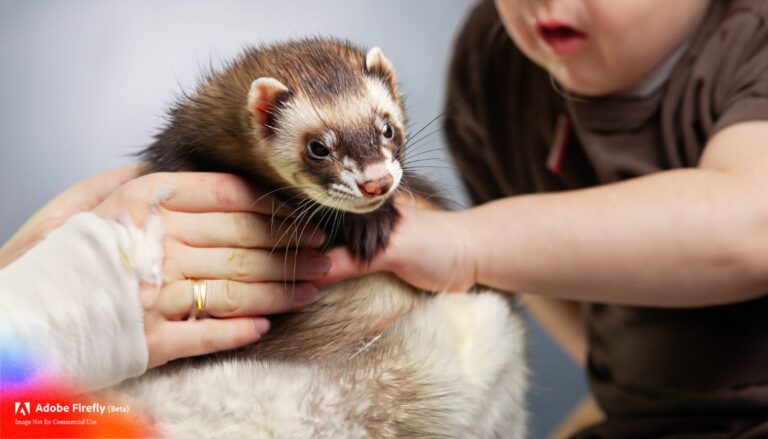
Have someone else hold the ferret while you take the picture. Show them interacting with each other. Remember, kids and animals are always winners when it comes to photography subjects. (However, use caution if the child is not familiar with handling ferrets. Always supervise and remove the ferret if either becomes anxious or aggressive.)

There are many cute ferret costumes and hats and shirts available. Try one on your ferret and place her in an appropriate setting that matches the outfit.

Beware of flash photography – the bright light could frighten or startle your ferret.

Once you have a photo you like, you may be able to use scrapbooking accessories to create a cute montage. Consider adding cartoon “thought balloons” to add a humorous or sweet touch.

Set some photographs aside that are dated and show important characteristics of your pet ferret (unique colorings, etc.). Compare them over time and alert your vet to any changes you notice (unusual growths, drastic changes in weight, etc.). These photographs can be invaluable in diagnosing your ferret.

Photographing your pet ferrets is a great way to bond with your fuzzy and create lasting mementos. If you get what you consider to be a great shot, why not enter it in a photography contest or submit it to a ferret publication? You and your fuzzy could become famous.

Ferret Aggression and Ways to Stop It

I’ve found that a frequent concern among new ferret owners is ferret aggression and how toPanda Ferret stop it. Well, my friends, there could be several reasons why your fuzzy is aggressive and bites. And there are several ways to stop this behavior in pet ferrets.

One reason for your fuzzy’s aggression and nipping could be as simple as fear. This is often the case when your ferret is new to your home.

Think about it. How do you feel and act when you’re in a new, unfamiliar place and are around strange people? You probably don’t enjoy it all that much and get at least a little nervous. And because you are nervous, you will act in ways that show that nervousness. You may eat more than usual, smoke more than usual, talk too much, become withdrawn, and so on

Well, in the same way, your ferret may bite, hiss, and/or screech. He may even attempt to hide if he can. These are natural reactions to the new setting. So the trick is to do everything possible to make your ferret feel safe and comfortable.

The best thing you can do for new pet ferrets is to handle them a lot, talking to them in a very reassuring tone. The best advice I ever got on this was from Kim Schilling in her book Ferrets for Dummies. And that is to get a sleep sack or small backpack, place your ferret in it, secure it around your front, and carry your fuzzy around with you. Also, when you’re sitting or lying on the couch, keep your hand inside the sack, and pet and love on your fuzzy. This will help your fuzzy become a cuddler instead of a nipper.

Or maybe your fuzzy is acting aggressively because he is in pain. He may have a tummy ache, or maybe his ears hurt due to an ear-mite infestation. Or there could be other health problems causing the pain and the ferret aggression. In this case, when you treat the health problem, the aggression usually takes care of itself.

If you have a kit, it could be, like all babies, teething and using you as a chew toy. Give him something to chew on besides you. You can try treats made especially for ferrets or a toy that is ferret safe. Do not use a rubber toy made for puppies or kittens. Parts of the toy, broken or bitten off, could be swallowed, causing blockage in your ferret’s stomach and intestines. So make sure the toy is ferret safe.

Another possibility is that your fuzzy just wants to play tag. Tag is their all-time favorite game. Rikki and Possum will run and jump at my feet and nip at my ankles. That is my cue to run at them and tag them. Actually, I’m on my hands and knees after them. This way, I don’t run the risk of stepping on them.

Now that we have covered some of the reasons for aggressive behavior in ferrets, let’s see what can be done about it.

The one thing I want to stress is this: DO NOT strike your ferret. That will cause more fear and probably more biting. Your fuzzy will associate hitting with you and so may not want to have anything to do with you. This could also physically harm your fuzzy baby.

One method I have learned to curb ferret aggression that really works is what I call “scruffing.”

I nab my fuzzy by the scruff of the neck (in the same way a mama ferret would do to carryGetting Started with Pet Ferrets her baby or to discipline her baby) so I can have control of his head. Then, just like a parent, I scold my fuzzy and shake my finger at him. At the same time, I tell him, “No bite.” I then proceed to pet him and love on him. Ferrets respond better to affection and a loving tone of voice.

This procedure may have to be repeated and so may take a while to work, but never give up on your fuzzy. They never give up on you.

Rikki and Possum – An Update on My Pet Ferrets

I was just looking over my past posts on this blog. It seems I have covered a lot of topics – maintaining good ferret health, ferret odor, ferret toys, vaccines, food, litter, and illnesses.

In going over this list of post topics, it occurred to me that I haven’t written anything aboutRikki, My Female Albino Ferret Rikki and Possum in a while. And they are the main reasons I started this website.

So, here goes . . .

Rikki is still my “ADHD” albino fuzzy. I have had her 2 years now, and she is still going strong.

Possum is my 1-year-old panda woozle. He was my laid-back chubby woozle. He’s still laid back, but he finally lost his baby fat. He isn’t as active as Rikki, but he still plays a lot, especially when he can get Rikki to play in the dig box with him.Possum, My Male Panda Ferret

I think their favorite game to play is tag, especially if I play with them. It seems like I’m the one who is always “IT” because they are a lot faster than I am – and I can’t fit under my bed and dresser. That’s where Rikki and Possum always run to keep me from tagging them.

After a game of tag, which usually lasts 15 to 30 minutes, then it’s dig-box and tube time. And that will last around 2 hours. After that, it’s nap time. By then, I’m ready for a nap too.

So Rikki and Possum are still doing great. And they are as ornery as ever.

Pet Ferrets and . . . Warts!?

Here’s a new one for you ferret lovers. Someone recently asked me this question: “DoFerret Playing in Tube System ferrets cause warts?”

No, my friend, ferrets do not cause warts. But – and this is something a lot of people don’t know – ferrets can get warts. And through some research, I found that ferrets cannot pass warts to humans.

Warts on a human are skin growths caused by a virus in the Human Papillomavirus (HPV) family. This virus causes rapid growth of a hard protein (called keratin) in the top layer of skin, which then results in warts.

After doing some research and talking to veterinarians, I found that the “warts” on our little fuzzies are actually Subaceous Epitheliomas, wart-like tumors that are usually benign. If your woozle has anything like these, you should take your fuzzy to the vet. You should never take a chance with your fuzzy baby!

So, the answer to the original question is: “No, pet ferrets cannot pass warts to us, their human parents.”

Find out much more about ferret health and ferret care in Getting Started with Pet Ferrets.


Donna Cartwright – An Artist from Wales and Her Pet-Ferret Paintings

Okay, so we all know ferret lovers are a little “crazy” when it comes to our fuzzy friends. We do many things the outside world just can’t seem to understand – like having ferret pictures painted on a custom-made wooden chair.

I’ve seen a lot of searches lately for ferret gifts for humans. Well, now, I have a great idea for all the ferret lovers who visit this site . . .

Donna Cartwright, an artist from Wales – yep, that’s the UK Wales, land of unpronounceable names and misty mysterious legends – recently contacted me. She explained her work and told me about how she had been commissioned by a woman to paint ferrets on a . . . chair.

When Donna contacted me, I immediately went to her website – Ferret Paintings on Chairwww.donnacartwrightcreates.com – to look at her artwork. At the time, the ferret art wasn’t done, but I totally fell in love with her other work, especially the painted vases.

When she got the ferret-painting-adorned chair finished, Donna sent me pictures of it. I loved it!

Now, I want a chair with my fuzzies painted on it. I told my husband, and, of course, he said, “No.” But I’m still working on him. I’m the type who doesn’t really take “No” for an answer.

I encourage you to go to Donna’s site – www.donnacartwrightcreates.com – and take a look at her very impressive painting. You will love her work!

You can also contact Donna Cartwright here. I’ll keep you posted about Donna’s work (hopefully, more ferret stuff) as information and pictures become available.

Black-Footed Ferrets as Pets?

I have seen the question “Why is it illegal to own black-footed ferrets as pets?” several times on this site, and I have never answered it. Well, my friends, I am finally getting around to answering this question – and I apologize for not getting to it sooner.

The answer to the question is really quite simple. You cannot own a black-footed ferret because they are on the Endangered Species List. And as with all endangered animals, it is illegal to have them as pets.

The black-footed ferret is the only ferret that is native to North America. Their main food source is the prairie dog. Because prairie dogs were considered a nuisance for livestock and land, their eradication began. And because their food source was being killed off, so was the black-footed ferret.

In 1960, it was realized that the black-footed ferret was in danger. In 1967, the black-footed ferret was classified as an Endangered Species. In 1973, the black-footed ferret was one of the first species to be put on the current Endangered Species List.

And that is the reason why it is illegal to own a black-footed ferret. Plus, I think would be nearly impossible to get one, considering they are highly protected.

If you would like to learn more about the black-footed ferret, you can go to the official website of the Black-Footed Ferret Recovery Implementation Team (BFFRIT): www.blackfootedferret.org

I learned about the black-footed ferret from this site and from Kim Schilling’s Ferrets for Dummies.

Vaccinations for Pet Ferrets?

To vaccinate your fuzzy or not to vaccinate your fuzzy? is the question.

There are two vaccinations that woozles certainly need: canine distemper and rabies.

If you have a baby ferret (kit), it will need three (3) sets of live canine distemperPanda Ferret Playing in Bag vaccinations. These 3 sets of distemper vaccinations are given as follows: at 8 weeks, at 12 weeks, and again at 16 weeks of age. Some veterinarians, however, may give the canine distemper vaccinations to young ferrets at 8, 11, and 14 weeks of age.

If your kit is more than 16 weeks old and you know your new fuzzy baby’s vaccination history, then he or she will need only 2 distemper shots. These 2 shots will need to be 3 to 4 weeks apart.

When you take your kit to the vet, be sure to discuss these distemper vaccinations and find out all you can. The reason is that your little fuzzy should get only the USDA ferret-approved vaccine – the one that is strictly for canine distemper. You and your fuzzy’s doctor should avoid using a canine distemper vaccination that also has canine hepatitis, leptospirosis, parainfluenza, or others. Your fuzzy should not be vaccinated for any of these diseases.

Now, on to the second shot – the rabies vaccination.

Your kits should be 12 to 18 weeks old before they get the rabies vaccination. The reason I said 12-18 weeks is that some vets will give the shot at 12 weeks, and some like to wait until the fuzzies are 14-18 weeks old because your fuzzies’ birthday may have been recorded wrong. Again, safety is always a chief concern.

If your new woozle is an adult that you have adopted and you are uncertain about its vaccination history, go ahead and have him or her vaccinated. It’s always better to be safe than sorry.

Your new adult fuzzy will need only 2 vet visits. The first visit will need to be for the first canine distemper shot. Wait about 3 weeks and then get your fuzzy back to the vet for a second distemper shot as well as the rabies shot.

Another thing to be aware of is that, just like human children, ferrets can have allergic reactions to their vaccinations.

An allergic reaction (anaphylaxia) isn’t really all that common in pet ferrets. But when it does occur, it usually rears its ugly head within 30 minutes of the shot. It can also, though less often, pop up its head up to 24 hours later. Generally, though, your woozle should be all right after the first 24 hours.

Following are some of the common signs of anaphylaxia:

  1. Vomiting
  2. Area around eyes and nose may swell
  3. Diarrhea (could be bloody)
  4. Lethargy
  5. Pale mucous membranes (that is, the tissue around the gums or eyes)
  6. Your fuzzy could also have seizures

So watch out for these signs. If you notice any of them, take your little fuzzy back to the vet. And, more than likely, the vet will give your poor fuzzy another shot. This one will probably be an antihistamine and/or cortisone.

To vaccinate your fuzzy or not to vaccinate your fuzzy? was the question. And now, well, the answer to that silly question is: YES, vaccinate your little fuzzy!

Two Pet-Ferret Matters – Climbing on the Cage and Covering the Ferret Cage

I’d like to discuss two matters concerning pet ferrets in this post.

The first is ferrets climbing on their cage. This behavior is perfectly normal for ferrets. Rikki and Possum are constantly climbing on their cage, especially Possum, my male panda ferret.

The cage I have for my two ferrets is a small- to medium-sized three-level cage. To get fromFerret Cage and Pet Ferrets the floor to the first level, my ferrets make use of a tube. Then, to get to the second level, they have to go up a spiral slide. And to get to the third level, they go up a ramp.

When I first got Possum, he refused to use the tube or the slide or the ramp. He would just climb up the side of the cage to get to each level. After a couple of months, he finally started using the tube, slide, and ramp. But even then, when the mood struck him, he would still – and still does – climb up the cage to get to the level he wanted.

Rikki (my older female albino ferret), on the other hand, climbs the cage only when she’s bored and wants out. But this is okay – it’s just the nature of ferrets. They love to climb.

Now, the other thing I’d like to talk about is covering your ferrets’ cage at night.

Covering the ferret cage is actually up to the human parents of the little fuzzies. You can choose whether or not you want to put a cover over your fuzzy babies’ cage at night.

I, personally, don’t cover my ferrets’ cage at night. I don’t have any real reason why I don’t do this – I just don’t.

I you do choose to cover the ferret cage in order to make the cage dark, hoping that your pet ferrets will sleep quietly through the night . . . just be aware that this is not going to happen.

Nope. If your fuzzies want to have a midnight romp, they will do it – whether their cage is covered or not.

That’s why I always try to get mine out their cage for several hours each day. Ferrets play extremely hard for a few hours, and then they sleep the rest of the time. The idea is that they will play and get tired so they’ll sleep longer at night. Sometimes it works – sometimes not.

Covering the ferret cage also depends on where you live and whether your ferrets live outside or inside. My fuzzies are inside pets, and my house is fairly warm in the winter and cool in the summer. So I don’t see a reason to cover up my ferrets’ cage at night.

Ferret BookTo cover or not to cover – it really is up to you.

Pet ferrets, being the ornery, independent little critters they are, will climb on their cages and will sometimes keep you awake at night, covered or not.