Black-Footed Ferrets as Pets?

I have seen the question “Why is it illegal to own black-footed ferrets as pets?” several times on this site, and I have never answered it. Well, my friends, I am finally getting around to answering this question – and I apologize for not getting to it sooner.

The answer to the question is really quite simple. You cannot own a black-footed ferret because they are on the Endangered Species List. And as with all endangered animals, it is illegal to have them as pets.

The black-footed ferret is the only ferret that is native to North America. Their main food source is the prairie dog. Because prairie dogs were considered a nuisance for livestock and land, their eradication began. And because their food source was being killed off, so was the black-footed ferret.

In 1960, it was realized that the black-footed ferret was in danger. In 1967, the black-footed ferret was classified as an Endangered Species. In 1973, the black-footed ferret was one of the first species to be put on the current Endangered Species List.

And that is the reason why it is illegal to own a black-footed ferret. Plus, I think would be nearly impossible to get one, considering they are highly protected.

If you would like to learn more about the black-footed ferret, you can go to the official website of the Black-Footed Ferret Recovery Implementation Team (BFFRIT): www.blackfootedferret.org

I learned about the black-footed ferret from this site and from Kim Schilling’s Ferrets for Dummies.

Vaccinations for Pet Ferrets?

To vaccinate your fuzzy or not to vaccinate your fuzzy? is the question.

There are two vaccinations that woozles certainly need: canine distemper and rabies.

If you have a baby ferret (kit), it will need three (3) sets of live canine distemperPanda Ferret Playing in Bag vaccinations. These 3 sets of distemper vaccinations are given as follows: at 8 weeks, at 12 weeks, and again at 16 weeks of age. Some veterinarians, however, may give the canine distemper vaccinations to young ferrets at 8, 11, and 14 weeks of age.

If your kit is more than 16 weeks old and you know your new fuzzy baby’s vaccination history, then he or she will need only 2 distemper shots. These 2 shots will need to be 3 to 4 weeks apart.

When you take your kit to the vet, be sure to discuss these distemper vaccinations and find out all you can. The reason is that your little fuzzy should get only the USDA ferret-approved vaccine – the one that is strictly for canine distemper. You and your fuzzy’s doctor should avoid using a canine distemper vaccination that also has canine hepatitis, leptospirosis, parainfluenza, or others. Your fuzzy should not be vaccinated for any of these diseases.

Now, on to the second shot – the rabies vaccination.

Your kits should be 12 to 18 weeks old before they get the rabies vaccination. The reason I said 12-18 weeks is that some vets will give the shot at 12 weeks, and some like to wait until the fuzzies are 14-18 weeks old because your fuzzies’ birthday may have been recorded wrong. Again, safety is always a chief concern.

If your new woozle is an adult that you have adopted and you are uncertain about its vaccination history, go ahead and have him or her vaccinated. It’s always better to be safe than sorry.

Your new adult fuzzy will need only 2 vet visits. The first visit will need to be for the first canine distemper shot. Wait about 3 weeks and then get your fuzzy back to the vet for a second distemper shot as well as the rabies shot.

Another thing to be aware of is that, just like human children, ferrets can have allergic reactions to their vaccinations.

An allergic reaction (anaphylaxia) isn’t really all that common in pet ferrets. But when it does occur, it usually rears its ugly head within 30 minutes of the shot. It can also, though less often, pop up its head up to 24 hours later. Generally, though, your woozle should be all right after the first 24 hours.

Following are some of the common signs of anaphylaxia:

  1. Vomiting
  2. Area around eyes and nose may swell
  3. Diarrhea (could be bloody)
  4. Lethargy
  5. Pale mucous membranes (that is, the tissue around the gums or eyes)
  6. Your fuzzy could also have seizures

So watch out for these signs. If you notice any of them, take your little fuzzy back to the vet. And, more than likely, the vet will give your poor fuzzy another shot. This one will probably be an antihistamine and/or cortisone.

To vaccinate your fuzzy or not to vaccinate your fuzzy? was the question. And now, well, the answer to that silly question is: YES, vaccinate your little fuzzy!

Two Pet-Ferret Matters – Climbing on the Cage and Covering the Ferret Cage

I’d like to discuss two matters concerning pet ferrets in this post.

The first is ferrets climbing on their cage. This behavior is perfectly normal for ferrets. Rikki and Possum are constantly climbing on their cage, especially Possum, my male panda ferret.

The cage I have for my two ferrets is a small- to medium-sized three-level cage. To get fromFerret Cage and Pet Ferrets the floor to the first level, my ferrets make use of a tube. Then, to get to the second level, they have to go up a spiral slide. And to get to the third level, they go up a ramp.

When I first got Possum, he refused to use the tube or the slide or the ramp. He would just climb up the side of the cage to get to each level. After a couple of months, he finally started using the tube, slide, and ramp. But even then, when the mood struck him, he would still – and still does – climb up the cage to get to the level he wanted.

Rikki (my older female albino ferret), on the other hand, climbs the cage only when she’s bored and wants out. But this is okay – it’s just the nature of ferrets. They love to climb.

Now, the other thing I’d like to talk about is covering your ferrets’ cage at night.

Covering the ferret cage is actually up to the human parents of the little fuzzies. You can choose whether or not you want to put a cover over your fuzzy babies’ cage at night.

I, personally, don’t cover my ferrets’ cage at night. I don’t have any real reason why I don’t do this – I just don’t.

I you do choose to cover the ferret cage in order to make the cage dark, hoping that your pet ferrets will sleep quietly through the night . . . just be aware that this is not going to happen.

Nope. If your fuzzies want to have a midnight romp, they will do it – whether their cage is covered or not.

That’s why I always try to get mine out their cage for several hours each day. Ferrets play extremely hard for a few hours, and then they sleep the rest of the time. The idea is that they will play and get tired so they’ll sleep longer at night. Sometimes it works – sometimes not.

Covering the ferret cage also depends on where you live and whether your ferrets live outside or inside. My fuzzies are inside pets, and my house is fairly warm in the winter and cool in the summer. So I don’t see a reason to cover up my ferrets’ cage at night.

Ferret BookTo cover or not to cover – it really is up to you.

Pet ferrets, being the ornery, independent little critters they are, will climb on their cages and will sometimes keep you awake at night, covered or not.

Christmas Ferret Toys and Ferret Gifts – Commercial or Homemade?

Guest Post by Michael Hearing

Pet ferrets absolutely must have daily play time, as well as something to play with. Pick up any ferret magazine or check out any ferret website, and you will likely see countless ferret toys for sale. You may also find directions for making your own ferret toys. Is there an advantage to commercially produced toys over homemade ferret toys or vice versa?

Commercially produced toys:

  • Are designed specifically for ferrets to play with. They use materials that are safe forFerret Playing in Tube System ferrets and made with ferret safety in mind.
  • Are produced in bulk so they are generally less expensive than they would be if you made them at home using identical materials.
  • Can be returned if they break (if you keep the receipt).
  • Often come with instructions for games you can play with your ferret.
  • Can be of better quality. A manufacturer does not want to deal with hassle of shoddy workmanship.
  • Can lead you to resources for other ferret information if you order them from a catalog, website, or magazine.
  • Will look exactly as they are pictured in the ad, on the box, in the catalog, or on the site.
  • Can be enjoyed the day of purchase (if bought at a brick-and-mortar store).

On the other hand, commercial toys:

  • Can be more expensive than homemade toys because a commercial manufacturer has to price the item to make a profit and also cover packaging and other costs of doing business. Also, if you purchased them online or via a catalog, you may have to pay significant shipping and handling fees.
  • Can be a hassle to return for a refund or an exchange.
  • May expose you to increased “junk” emails and surface mail if the company manages to get your contact information during the sale.

If you choose to buy a commercial product, look for a toy designed specifically for ferrets made by a company that has expertise in and knowledge of ferrets. If necessary, carefully read the specifications to be sure the toy will fit your ferret’s situation. Check out the company’s return policy and save your receipt.

Homemade toys:

  • Can be virtually free if they are created from items you already have around theFerret Playing in Box house.
  • Can be fun to create.
  • Encourage you to develop your own talents.
  • Are unique. No other ferret will have exactly the same toys yours does.
  • Can become a source of income if you develop a toy that others may wish to buy for their ferrets.
  • Are a labor of love for your pet (or as a gift for a fellow ferret lover).

On the other hand, homemade toys:

  • May be unsafe because the materials used may not be healthy or safe for ferrets.
  • Take time, money, and skill to produce.  Your ferret won’t be able to play with them until they are done.
  • Can’t be returned to a store if the item just doesn’t work well for your ferret.
  • May require the sacrifice of a favorite item (such as a T-shirt or blanket) for your fuzzy’s pleasure.

If you decide to make your own ferret toys, read and follow all instructions carefully. Use only materials safe for ferrets (e.g., no cedar chips, no Styrofoam peanuts, etc.). Make sure all openings are at least 4 inches in diameter and that all toys are at least 2 inches in diameter.  Make sure all seams are thoroughly sealed and all rough or sharp edges removed. Don’t hesitate to discard or remake an item if it appears unsafe for your ferret.

It’s easy to see, then, that there is no one-size-fits-all answer about which kind of ferret toy is best. Most ferret households have a mixture of both commercially produced and homemade toys.

Cleaning the Ferret Cage

I recently went back and read through my blog posts and noticed that I have mentionedFerrets in Ferret Cage cleaning my fuzzies’ cage a couple of times. And my husband has written about cleaning the cage with ferret “help.” But I haven’t written about ferret-cage cleaning in any kind of step-by-step detail.

So what I am going to discuss today is exactly how I go about cleaning my ferrets’ cage.

First, I get my fuzzies out of the cage so they can run and play. Then I get their water and food dishes out and wash them with warm soapy water and then rinse them thoroughly. (I clean Rikki’s and Possum’s dishes in my bathroom, never in my kitchen sink.) After cleaning and drying my ferrets’ dishes, I get some dry kibble (which I have previously ground up in a small electric chopper/grinder) and put it in the food dishes and add a little water. (Rikki, my older albino ferret, eats it better this way.)

While the ferret food is soaking, I take out the litter boxes – Rikki and Possum have three litter boxes – and scoop out the nasty litter and poop. About once or twice a week, I wash out their litter boxes with soap and water and then spray them with a bleach solution. I use a spray bottle that holds about 20 oz. (maybe a little more). I put about 2 to 3 oz. of bleach in it and fill it the rest of the way with water. After I rinse the litter boxes, I let them dry.

Next, I proceed to clean out the rest of the cage. I use a shop vac to vacuum up the spilled litter, food, and other unmentionables. After I get the whole cage thoroughly vacuumed, I spray all surfaces with the bleach solution and wipe it down with an old wash cloth. Then, using another spray bottle filled with water only, I spray and wipe the cage again.

I use the bleach solution for ferret-cage cleaning because the same thing is used at many daycares. I figure that if it’s safe enough for infants, it should be safe enough for pet ferrets. Some vets and pet stores also use a similar bleach solution.

I make sure to keep the cage locked up while it is drying. This is to make sure Rikki and Possum don’t sneak in and mess it up.

After the cage has dried, I get the litter boxes (and finish drying them if needed) and put fresh litter in them. Then I put the boxes back in the cage, making sure they are secured to the cage’s sides. If you don’t secure them, you’ll soon have litter all over the bottom of the clean cage – and the litter boxes will be upside down too.

After this, I open up the lower cage door so Rikki and Possum can get back in when they’reHappy Pet Ferrets ready. Then I get their food and add a little more water. (Rikki likes her food a little soupy.) I put the food dishes back in the cage – with my fuzzy kids following closely because they know it’s chow time! I next fill the water bowl, add food to their dry-kibble bowl, and then lock the cage doors. And Rikki and Possum now have a clean home.

I do want to warn you about one thing, though. You will have a lot of “help” cleaning a ferret cage! Just ask my husband about that.

In Memoriam – A Tribute to a Beloved Family Member

I know this website is about ferrets and for ferret lovers, but I have been wanting and needMaggie Watching to tell everyone about one of the most “Moo-nique” animals ever. Yes, I said “Moo-nique.” This was a term my husband came up with for his dog, Maggie Moo.

Maggie was a two-year-old blue heeler-chocolate lab mix. But she was more than a dog to us. She was one of our children. (But, then, all of our animals are more like kids than pets.)

Our Maggie was very special. She didn’t have a mean bone in her body. She loved everyone, especially children and puppies. And her most beloved playmate was Linus, our golden Pyrenees.

Maggie also liked Rikki and Possum. In fact, one day when we were gone for several hours and Maggie was loose in the house, Rikki, my albino ferret, got out of my room. When we got home, there was Maggie lying on the couch with Rikki running around playing – completely unharmed.

Maggie loved playing with Linus and going out to chase squirrels with him. Another one of her favorite pastimes was chasing cows out of our lake. She was constantly on the watch for the cows. If she saw them getting close, she would lie out in the yard by our deck to make sure they didn’t get into the lake.

I think the person Maggie loved most in the world was her dad (my husband). He got Maggie twenty-one months ago. Someone had put her in his car while he was at church, and my husband didn’t find out who did it till a year later. The culprit was our daughter, Audrey.

Aude is my husband’s little girl. But then she grew up and moved out on her own. So then,Maggie Moo Maggie became his little girl. My husband and Maggie had a very special bond. He is so lost without her because they did so many things together.

Maggie would always go out with my husband to feed the horses. And whenever he went fishing, she was right there with him catching frogs, getting muddy, and scaring the fish away. At night she would let him know when she wanted her milk, and then she would say “please” as he got ready to put milk in her bowl. And at 10:00 every night, Maggie let my husband know that it was bedtime and that she was ready to go get in his bed.

On November 26 of this year, Maggie just disappeared. She and Linus went out to chase squirrels that morning as they did almost every morning. Later, Linus came back home, but Maggie didn’t. We have searched and searched, put ads in papers, posted flyers, talked to neighbors and ranchers and hunters – but we still have no clue about where she is or what happened her.

Come to think of it, though, this is kind of related to pet ferrets. Cherish your fuzzy little kids while you can because you never know when you will lose them.

Goodbye and thank you, Maggie. We love ya, girl!

Introducing New Pets – Pet Ferrets and a Puppy

Rikki and Possum just got a new baby brother, a seven-week-old puppy. His name isPet Ferret and Puppy Samson.

They weren’t too sure what to make of him when they were first introduced. And Samson sure didn’t know what to think of Rikki and Possum.

At first, they all did the smelling of one another. Then, Rikki decided she wasn’t very interested in Samson and decided to do her own thing and go play.

Samson figured out pretty quickly that Rikki and Possum were just about his size and tried to play with Rikki. His way of playing was to try and get Rikki’s tail. Well, Rikki definitely didn’t go for that. She showed Samson that, although he was a little bigger, she could still whip up on him.

Samson decided he didn’t want what Rikki was dishing out, so he tried to get Possum to play with him. And Possum decided to accommodate him.

(I tried to take pictures to record the introduction of our new puppy and my little fuzzies, but that didn’t work out very well. I was laughing too hard to get any good pictures!)

Possum was jumping at Samson and doing the ferret happy dance. And Samson was trying to jump and do the happy dance too! Because he’s just a baby with not-so-good coordination, Samson kept falling over . . . with Possum then jumping on him.

Finally, Possum decided he didn’t want to play like that anymore and started playing with Rikki in their ferret tube system. And Samson, of course, wanted to play in the tube with them. But that didn’t work out very well because he’s a little too fat for it. So he decided to jump on the tube instead. Rikki and Possum really liked that – and the games began again.

They ran in and out of the tube, and Samson raced after them. When Rikki and PossumFerret Playing with Puppy dashed into the tube, Samson jumped onto the tube and tried to get to them that way. Of course, he was a little too slow for my quick woozles. While he was still looking for them in the tube, they would already be under my dresser with their heads sticking out and watching Samson make a fool of himself. It was great fun watching them.

I made sure to run interference in case Samson caught up with the fuzzies – just to make sure he didn’t get too rough with them. Since he’s just a puppy, he doesn’t realize that he could hurt them.

I do advise that when you introduce new pets to your ferrets, always make sure to supervise and never leave them alone together. If you don’t supervise the introductions, an accident could happen.

Welcome to the family, Samson!

Christmas Ferret Toys

I’ve been getting a lot of enquiries lately about Christmas presents for little fuzzies.Ferret Playing in Box

There are a lot of toys out there (from inexpensive to very expensive) for our ferrets. But there are also a lot of ideas for your fuzzy in your head. All you have to do to come up with some great inexpensive Christmas ferret toys is let those ideas run wild – while using just a little common sense to ensure ferret safety.

Actually, my fuzzy kids have more toys than my human kids did when they were little. Not only do I buy my woozles toys, but I also make them homemade toys.

Fuzzies love boxes and tunnels. What I do is take a box, cut a hole in one end, and then tape up the flaps. Their tunnel systems I bought from Amazon and Doctors Foster and Smith. Rikki and Possum play for hours running in and out of their boxes and in and out and through their ferret tunnels.

And you can’t go wrong with a big box. I know it sounds silly buying a box filled with packing peanuts made out of starch for ferrets. But it is well worth it when you see how much they play in it. You can get these big boxes and starch peanuts from Doctors Foster and Smith.

Rikki and Possum also have many different-sized balls. Most of them are balls made for cats and range in size from ones like soccer balls to those for small kittens. One thing I make sure of is not to get soft rubber balls or balls with strings attached. If bits or pieces were ingested, these could result in choking or blockage in fuzzy kids.

Rikki and Possum also have the kind of cat toys that resemble a stick with a dangly toyFerret Playing with Cat Toy attached to an elastic band. They love these.

The cheapest toys you can give your pet ferrets are SACKS! They will go crazy with them. If you give your ferrets plastic sacks from Wal-Mart or other stores, make sure you supervise your little fuzzies to guard against choking or smothering hazards. Paper sacks are the best!

There are so many things lying around the house that are fun and safe for your ferrets. It doesn’t really take much to entertain your little babies, and it doesn’t have to cost much. To them it’s the thought that counts. 

Get more great ideas for ferret toys and tips on ferret care in Getting Started with Pet Ferrets.

Are Ferrets Good Pets for Children?

I have been asked if a ferret would make a good child’s pet. I would say yes, BUT only ifCute Panda Ferret the child is very responsible and probably around twelve years old.

I have five grandchildren ranging in age from one to eight. And I would not encourage any of them to get a fuzzy unless their parents (my human kids) took full responsibility for care of the pet ferrets, as well as carefully supervising when the kids are playing with the woozles.

I have stressed before that ferrets are high-maintenance critters – not just money-wise, but also care-wise. I also wrote a previous post about ferret-rescue shelters that are full of little fuzzies that have been abused and/or were unwanted. Often, people got these pet ferrets – and sometimes it was for their children – without realizing the money and time commitments involved.

I am not saying that you should never get a child a pet ferret because I have met responsible children. But we have to keep in mind that they are, after all, children. They don’t understand the time commitment. Usually, children just see what they want – and they want it now.

Just make sure to do a lot of research before you make the ultimate decision on getting your child a wonderful little fuzzy!

Safe Ferret Toys for Happy Pet Ferrets

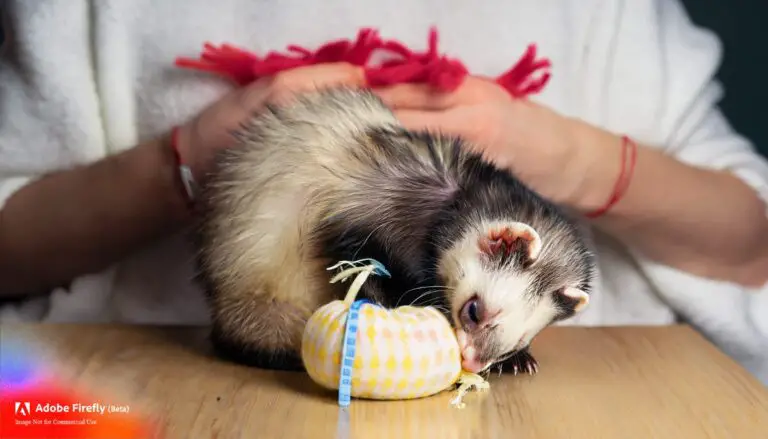
New ferret owners often have many questions about ferret toys. It’s easy to think that justPanda Ferret Playing with Ferret Toy any small object will work as a ferret toy, but there are some important safety features to consider. Here are some guidelines to follow.

Chew toys – Ferrets were built to gnaw, so they really like chew toys.  Your best bet is to buy chew toys made specifically for ferrets because they are made to withstand those sharp teeth. There are several brands of chew toys on the market that can be readily found online.

Chew toys not made specifically for ferrets are acceptable IF they are not made of soft rubber, which can be broken off into little pieces that your fuzzy could choke on. This is especially true if the toy houses a jingle bell or some other noise-maker.

Rawhide chew toys made for dogs are also dangerous for your ferret.  As with soft rubber, a rawhide toy could break into pieces that could become embedded in your fuzzy’s throat. If the rawhide is swallowed, then it becomes an even bigger danger as your ferret would not be able to digest it. While a ferret laxative or hairball medication might help, you may need a veterinarian to remove a rawhide piece.

You may also be tempted to make your own ferret chew toys. Some people have done so by using large pieces of leather or even sewing together pieces of Velcro. However, be sure the pieces are large enough and sturdy enough for your active pet. And never connect them to wood, plastic, or other flimsy materials. If you fill the toys with a jingle bell or other small objects, make sure they are securely in place. Discard the toy if you find that it is wearing out.

Tubing – As you know, ferrets love to run through and around tubes. Any tubing that is at least 4 inches in diameter and made of sturdy plastic or other strong materials will make a fine toy. But be sure all edges are smooth and that there are no nails, screws, wires, or other objects protruding from the ferret tunnels.  If you link tubing pieces together, make sure the joints are secure and so your fuzzy won’t get caught in the spaces between them.

Water toys – Some ferrets, but definitely not others (like Rikki and Possum), love to play in the water, so it is great fun to watch them romp in a dishpan of water. Do supervise them at all times, and be sure the pan you use has at least one side that is no taller than 2 inches so your ferret can get out safely.  Put a washcloth or a hand towel at the bottom of a pan with a smooth surface. The water should be warm but not too hot or too cold. If your ferret is skittish at its first few attempts at water play, hold it and gently put its feet in the water, just as you would with a toddler.

Play yards – Some ambitious ferret owners build ferret runs and play yards. These allow their pets to run around freely without disrupting the rest of the household. If you decide to build one, make sure the walls are securely attached to each other. If you use fencing, make sure the holes are no more than 1 inch in diameter so your fuzzies won’t escape and predators can’t get in. The flooring should be solidly built of linoleum or some other hard surface. If you use a bedding material, do not use wood chips (splinters) or old newspaper (which your fuzzy could use as a litter box).

People and pets – Ferrets are very social beings, so their favorite toys are people and animals, especially other ferrets. Even these toys have an element of danger however. A toddler or anyone who has not been around ferrets will not know how to handle them correctly and may drop or otherwise endanger them.  They also may not know how to keep a ferret from becoming a little nipper.

Supervise your ferret in these and other circumstances until you are certain everyone is safe and respectful of boundaries.

No matter what you use as ferret toys, be sure they are inspected regularly.  Repair or replace any toys that have become worn out or are missing pieces. Make sure people or pets are completely comfortable with your ferrets – and your ferrets are comfortable with them.

For a more through treatment of ferret safety and ferret toys, both commercially produced and homemade ferret toys, take a look at Getting Started with Pet Ferrets.